



Rezoning in one paragraph
Rezoning in South Africa is the formal amendment of a municipality’s land use scheme to change the zoning, and therefore the land use rights, of a specific property. It is decided by the municipality under the Spatial Planning and Land Use Management Act 16 of 2013 (SPLUMA) and the local planning by-law, after public participation.
Key takeaways
- Rezoning changes what the law allows on your land. It is separate from title deed conditions and from building plan approval, and a project often needs all three.
- SPLUMA sets the national framework; your municipality’s by-law and land use scheme set the procedure. In Johannesburg that is the Municipal Planning By-law, 2016, as amended in 2023, in operation since 3 April 2024.
- In our practice an unopposed rezoning typically takes 6–9 months, and an opposed one 6–12 months. Statutory notice, comment and decision windows account for much of that time.
- Look beyond the application fee. Specialist studies, professional fees and infrastructure contributions usually make up most of the cost.
- Many changes need no rezoning at all. A consent use, a building line relaxation or the removal of a title condition is often the quicker, cheaper route.
What is rezoning?
Every property in South Africa carries a zoning in its municipality’s land use scheme. The zoning determines which uses are permitted and sets limits on density, coverage, floor area, height and building lines. Rezoning replaces that zoning with a different one, so the property carries a different set of rights: rights that attach to the land, not to the owner.
The land use scheme has the force of law. SPLUMA provides that land may be used only for the purposes the scheme permits, and Johannesburg’s by-law is equally direct: no one may use or develop land unless the scheme or an approval under the by-law allows it, and using land contrary to the scheme is a criminal offence.
What rezoning doesn’t do
- It doesn’t change the title deed.
- Title deeds can carry restrictive conditions, such as a rule that an erf may hold a single dwelling only. A rezoning leaves them in place. Where a condition conflicts with the intended use, a removal of restrictive conditions application is needed, and Johannesburg’s by-law allows it to run alongside the rezoning.
- It doesn’t approve a building.
- Rezoning settles what the land may be used for. Building plans are approved separately under the National Building Regulations and Building Standards Act 103 of 1977, once the new rights are in operation.
- It doesn’t take effect on approval.
- In the Gauteng metros an approved rezoning becomes an amendment scheme, which comes into operation only when notice of it is published in the Provincial Gazette.
- It doesn’t come unconditionally.
- Approvals usually carry conditions covering engineering services, contributions or design controls, and these must be met before the new rights can be used.
The practical starting point is the municipality’s zoning certificate, read with the title deed and the Surveyor-General diagram. Together they show what rights the property has today, what the title allows, and which servitudes and conditions are registered against it.
Do you need a rezoning?
Often not. Many changes of use or building form can be approved through a narrower application, such as a consent use, a building line relaxation or the removal of a title condition, and these are usually quicker and cheaper than a rezoning. You need a rezoning when the use or development parameters you want are not available under the property’s current zoning in any form.
Four questions to answer first
- What is the property zoned today? The zoning certificate and the land use scheme list the primary uses, which are allowed as of right, and the consent uses, which need the municipality’s permission.
- Is the use you want already listed? If it is a consent use in the current zone, a consent use application is the route, not a rezoning.
- Is the problem a parameter rather than a use? Building closer to a boundary, or exceeding a coverage or height limit, may be handled by a building line relaxation or, in municipalities that provide for them, a departure.
- Does the title deed stand in the way? A restrictive condition needs its own application, whatever the zoning allows.
The table below sets the main routes side by side. Choosing the least intrusive route that lawfully achieves the goal is often the most valuable decision in the whole process.
Not sure which route fits your property? Speak to a Planner. The first consultation is free and carries no obligation.
| Application | Use it when | What changes | Our service |
|---|---|---|---|
| Rezoning | The use or parameters you want are not available in the current zone | The zoning itself, through an amendment of the land use scheme | Rezoning |
| Consent use | The use is listed as a consent use in the current zone, as many guesthouses and home businesses are | Nothing in the zoning; the municipality permits the listed use, often with conditions | Consent Use |
| Building line relaxation or departure | You need to depart from a building line or another parameter without changing the use | The specific restriction, usually for a particular building proposal | Building Line Relaxation; Departures and Permissions |
| Removal of restrictive conditions | A condition in the title deed prohibits or limits the intended use | The registered condition, which is amended, suspended or removed | Removal of Restrictive Conditions |
| Subdivision or consolidation | You want to divide an erf, or join adjoining erven | The property boundaries; rights follow the scheme or a concurrent rezoning | Subdivision; Consolidation |
| Township establishment | You are creating new erven, streets and public places on a farm portion or agricultural holding | A new township, with its own conditions and zonings | Township Establishment |
What law governs rezoning in South Africa?
Rezoning in South Africa sits inside a layered framework. The Constitution makes municipal planning a municipal function. SPLUMA sets national principles and procedures, and provincial planning laws add to them in some provinces. Each municipality’s planning by-law sets the working procedure, its land use scheme defines the zones, and its spatial development framework guides the decision.
- ConstitutionMunicipal planning is a municipal function (s 156 and Schedule 4, Part B)
- SPLUMA, Act 16 of 2013Development principles, spatial development frameworks, land use schemes, planning tribunals and appeals
- SPLUMA Regulations, 2015Procedure, tribunal membership and conduct, public participation
- Provincial planning lawProvincial rules in some provinces, such as the Western Cape Land Use Planning Act 3 of 2014
- Municipal planning by-lawApplication types, notice, decision-makers, timeframes and appeals
- Land use schemeZones, permitted uses and development parameters for every property
- Spatial development framework and policyWhere the municipality wants growth, density and investment
The municipality decides
In 2010 the Constitutional Court held that “municipal planning” includes zoning and township establishment, so the power to decide a rezoning sits with the municipality, not the province (City of Johannesburg v Gauteng Development Tribunal). Two later judgments reinforced the point. A mining right granted nationally does not excuse its holder from municipal zoning (Maccsand v City of Cape Town, 2012), and a province may not hear appeals against municipal planning decisions (Habitat Council, 2014).
The five development principles
Section 7 of SPLUMA sets five development principles that apply to every land use decision, and Johannesburg’s by-law requires every application to give effect to them. In plain terms:
- Spatial justice
- Redress past spatial imbalances by improving access to, and use of, land.
- Spatial sustainability
- Protect prime agricultural land, respect environmental law, contain sprawl, and weigh the full cost of infrastructure and services.
- Efficiency
- Make the most of existing infrastructure, and run application procedures efficiently, within timeframes every party keeps to.
- Spatial resilience
- Keep plans and land use rules flexible enough to sustain livelihoods in the communities most exposed to economic and environmental shocks.
- Good administration
- Integrated decisions across government, transparent public participation, and rules clear enough for the public to understand.
What the decision-maker must weigh
Section 42 of SPLUMA requires the tribunal to be guided by those principles, to decide consistently with the municipal spatial development framework and applicable policy, and to take into account the public interest, the facts of the application, the rights and obligations of everyone affected, and the state and impact of engineering services, social infrastructure and open space. A decision-maker may depart from the spatial development framework only where site-specific circumstances justify it (section 22).
Johannesburg’s by-law adds tests of its own. Every application must address need, reasonableness, desirability and public interest, and must aim at the “co-ordinated and harmonious development” of the area it concerns.
Provincial and municipal layers
In Gauteng, applications run under SPLUMA and the municipal by-laws. Johannesburg’s by-law came into operation on 1 September 2016, replacing the Town-planning and Townships Ordinance 15 of 1986 for new applications. The Western Cape adds its Land Use Planning Act 3 of 2014, and KwaZulu-Natal’s Planning and Development Act 6 of 2008 operates alongside the by-laws there. Rezoning decisions are administrative action, so the Promotion of Administrative Justice Act 3 of 2000 (PAJA) governs fairness, reasons and review.
How does the rezoning process work?
The sequence is broadly the same in every South African municipality; the by-law sets the detail. The periods shown are those in Johannesburg’s by-law, as a worked example.
Periods are calendar days. Johannesburg’s by-law leaves 15 December to 5 January out of its day counts.
Authorities: Johannesburg Municipal Planning By-law, ss 1, 16, 18, 21, 22 and 25; SPLUMA, s 35.
- Preparation
Confirm the current rights
Obtain the zoning certificate, title deed and Surveyor-General diagram, and check for restrictive conditions and servitudes.
Test the proposal against policy
Read the municipal spatial development framework and related policy, including, in Johannesburg, the Nodal Review Policy, to see whether the municipality wants this kind of development in this place.
Consult the municipality
A pre-application discussion with the planning department brings objections to the principle out early, while changing course is still cheap.
Commission specialist input
Traffic, engineering services, heritage, environmental or geotechnical reports, as the site and the proposal require.
Write the motivation
The motivating memorandum makes the case: need, desirability and public interest, alignment with the spatial development framework, and the section 7 principles.
- Submission and notice
Lodge and register the application
Submit the application with the fee. Notice can be given once the municipality has issued a registration reference number.
Give notice and invite objections
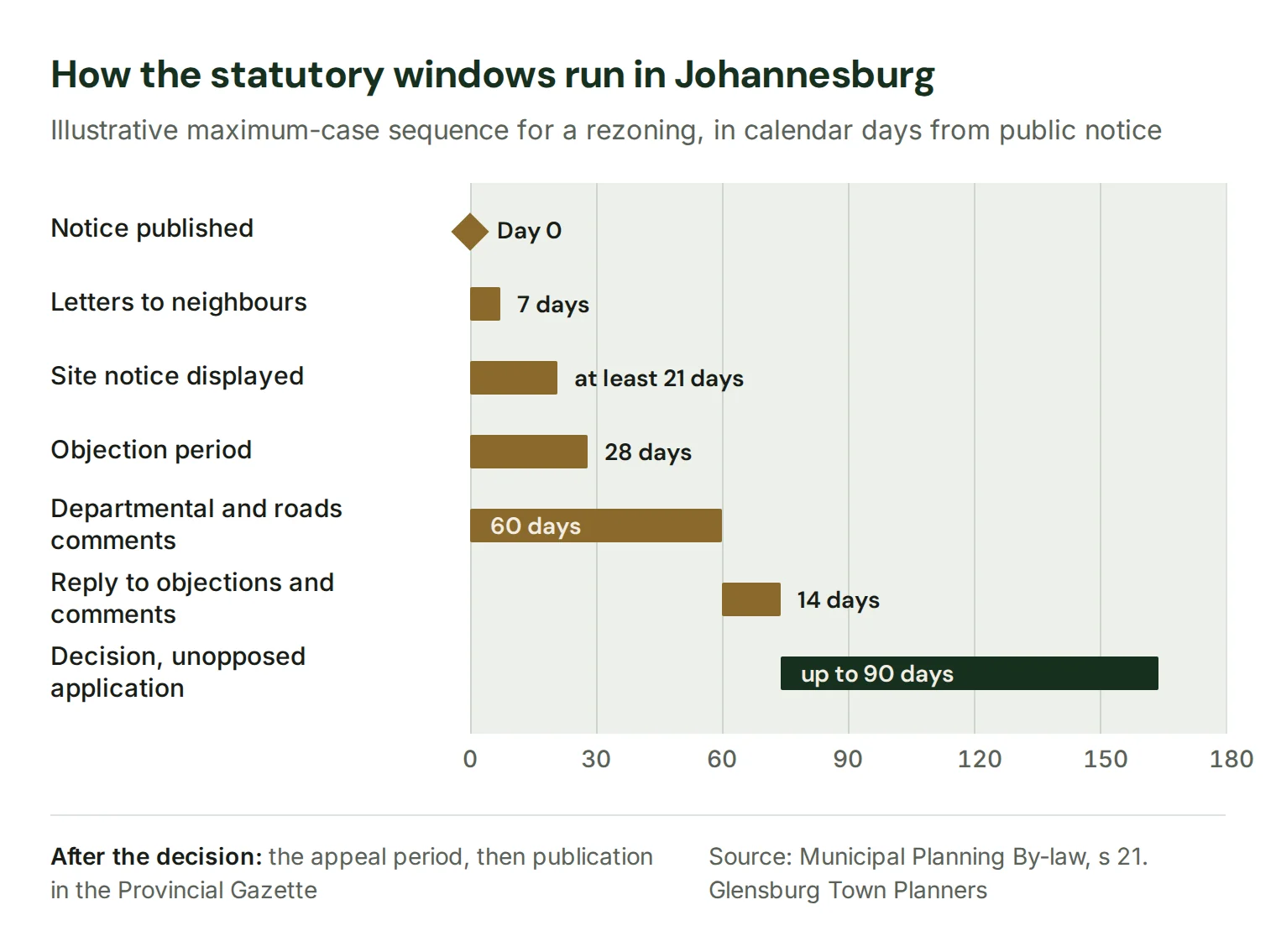
Publish notice once in the Provincial Gazette and a local newspaper, display a site notice for at least 21 days, and write to the owners of adjoining erven within 7 days. Objections are due within 28 days of publication.
Circulate for comment
The municipality sends the application to the roads authority, its departments and other bodies, which have 60 days to comment before they are taken to have no objection.
- Evaluation and decision
Reply to objections
The applicant receives every objection and comment, and may respond in writing within 14 days.
Decision
An authorised official decides an unopposed, complete application within 90 days after the administrative phase. An opposed application goes to the Municipal Planning Tribunal, where the applicant and objectors may be heard.
- After the decision
Appeal period and publication
Once the appeal period has passed, the approval is published in the Provincial Gazette as an amendment scheme, which comes into operation on the date of publication.
Conditions, contributions and building plans
Meet the conditions, pay any engineering services and open space contributions, then submit building plans. In Johannesburg, plans for the new rights are not approved until the contribution is settled.
How long does rezoning take?
In our practice, an unopposed rezoning typically takes six to nine months and an opposed matter six to twelve. The statutory notice, comment and decision windows account for much of that time; the rest goes to preparing the application, answering queries and objections, and publishing the approval.
The statutory windows add up. In Johannesburg, the 28-day objection period runs alongside the 60 days allowed for departmental and roads authority comment; the applicant then has 14 days to reply to the objections and comments it receives; and an authorised official has up to 90 days after the administrative phase to decide an unopposed application. Taken at their maximums, those windows exceed five months before the appeal period and publication even begin. Treat any promised decision date with caution.
What slows applications down
- Incomplete submissions. Decision periods run from a complete application, so missing documents cost time before the clock has properly started.
- Objections. An opposed application moves from an official to the Municipal Planning Tribunal, which adds a hearing.
- Comments that raise new questions. Roads, services or heritage comments can require further studies or design changes.
- Material revisions. Changing the proposal substantially after notice can mean giving notice again.
- The holiday period. In Johannesburg, 15 December to 5 January does not count towards prescribed periods.
- Appeals and court reviews. These fall outside the typical ranges. In one Sandown matter, a rezoning lodged in 2015 was approved by the Tribunal in 2018, confirmed on appeal in 2020 and set aside by the High Court in 2024.
| Application | Typical elapsed time |
|---|---|
| Rezoning, unopposed | 6–9 months |
| Rezoning, opposed | 6–12 months |
| Consent use | 4–6 months |
| Building line relaxation, supported | 2–3 months |
These are typical ranges from our own matters, not statutory periods or promises. Appeals and court reviews run on a separate, longer clock.
| Stage | Period | By-law provision |
|---|---|---|
| Objections after notice | 28 days from publication | s 21(2)(e) |
| Site notice on display | At least 21 days | s 21(2)(j) |
| Letters to adjoining owners | Within 7 days of publication | s 21(2)(k) |
| Affidavit proving notice | Within 14 days after objections close | s 21(3) |
| Comments from the roads authority, departments and others | 60 days, then deemed no objection | s 21(5) |
| Applicant’s reply to objections | 14 days | s 21(6) |
| Decision on an unopposed, complete application | Within 90 days after the administrative phase | s 21(8) |
| Request for reasons | 28 days from notice of the decision; reasons within 14 days | s 15(3) |
| Coming into operation | On publication in the Provincial Gazette, after the appeal period | s 22(4) and (7) |
| Contribution letter | 90 days to ask for repeal instead; payment 30 days after that | s 25(3) and (6) |
Source: City of Johannesburg Municipal Planning By-law, 2016, as amended in 2023 (Local Authority Notice 447 of 2024, Gauteng Provincial Gazette 117, 3 April 2024). Days are calendar days; 15 December to 5 January is excluded.
How much does rezoning cost?
The cost of a rezoning is the sum of several parts: the municipal application fee, notice and advertising costs, specialist studies, professional planning fees, infrastructure and open space contributions once the rights are approved, and possibly a change in property rates. The application fee is the most predictable part; studies and contributions vary most from site to site.
Municipal application fees for 2026/27
Fees are reset each year and apply from 1 July. For 2026/27, Johannesburg’s fee schedule sets the rezoning fee at R9 500 per erf or property in the application, unless the properties have the same owner and are contiguous, up from R8 252 in 2025/26. Ekurhuleni charges R5 627.24 including VAT, with the applicant paying for advertisements separately. Cape Town combines a basic fee with complexity and advertising fees, applied at the rates in force when the application is submitted. Check the schedule on the day you lodge.
Contributions: the cost most often underestimated
Where a rezoning adds load to municipal engineering services or raises residential density, the municipality can require contributions towards external engineering services and open space. In Johannesburg, the City sends a letter stating the amount and how it was calculated. The owner then has 90 days to ask for the amendment scheme to be repealed instead, and building plans for the new rights are not approved until the contribution is paid, although the City may allow instalments or deferral for up to three years on good cause.
Johannesburg’s by-law also provides for an inclusionary housing contribution in some circumstances. The national framework for these charges is set to change; see development charges below.
Rates
A new zoning or use can move a property into a different rating category under the municipality’s rates policy, changing what you pay every month. Build the ongoing cost into your feasibility, not only the once-off costs.
Want a view on the likely cost for your property? Speak to a Planner. The first consultation is free and carries no obligation.
| Cost | What it covers | How it is set |
|---|---|---|
| Application fee | Lodging the application with the municipality | Municipal tariff, reset each 1 July. Johannesburg 2026/27: R9 500 per erf or property. Ekurhuleni 2026/27: R5 627.24 including VAT |
| Notice and advertising | Provincial Gazette and newspaper notices, site notice, letters to neighbours | Publisher and newspaper rates, paid by the applicant |
| Publication of the approval | Publishing the approved amendment scheme in the Provincial Gazette | A separate municipal charge in Johannesburg’s tariff |
| Specialist studies | Traffic, engineering services, heritage, environmental or geotechnical work | Quoted by each specialist; driven by the site and the scale of the proposal |
| Professional fees | Preparing, lodging and managing the application, and any hearing | Scope, complexity, and whether the matter is opposed |
| Contributions | External engineering services, open space and, where applicable, inclusionary housing | By-law and municipal policy; calculated after approval |
| Rates | Ongoing municipal property rates | Rating category under the municipal rates policy |
How is a rezoning application decided?
A rezoning is approved when the decision-maker is satisfied that the change is the right planning outcome for that site, not simply because the owner wants it. The test turns on consistency with the spatial development framework, the SPLUMA development principles, need and desirability, the capacity of engineering services, and the effect on neighbours and the area.
In practice, the decision-maker and the officials who report to it tend to ask five questions.
- Does it fit the spatial development framework? A proposal the framework supports starts from strength. One that contradicts it needs site-specific reasons strong enough to justify a departure.
- Is there a need, and is this the right place? Need and desirability must be shown with evidence, not asserted.
- Can the services cope? Water, sewer, electricity, stormwater and roads, and who pays to upgrade them.
- What happens to the neighbours? Traffic and access, overlooking, noise, character and precedent.
- Are other laws engaged? Rezoning a site larger than 10 000 m² must be notified to the heritage authority, and altering a structure older than 60 years needs a heritage permit. Some proposals also need environmental authorisation under NEMA, which runs in parallel with the rezoning.
How we build a motivation
We argue each application on the SPLUMA section 7 principles as well as the by-law, because those principles bind the decision-maker. We deal with the objections a proposal is likely to attract inside the motivation itself, before they are lodged, so that by the time a matter reaches the Municipal Planning Tribunal the record already contains the answers. Where a hearing is needed, we represent the applicant at it.
Worked example (hypothetical)
Townhouses on a single-residential erf in Johannesburg
- Property
- A 2 000 m² single-residential erf about 500 m from a public transport node identified in the City’s Nodal Review Policy
- Land use scheme
- City of Johannesburg Land Use Scheme, 2018
- Application
- Rezoning from Residential 1 to Residential 3 for eight townhouses, with removal of a title condition limiting the erf to one dwelling
- Result
- Approved by an authorised official with no objections lodged, subject to engineering services and open space contributions; eight months from lodging to publication of the amendment scheme
The motivation began with the Nodal Review Policy, which supports higher residential densities within walking distance of the node, and then argued the section 7 principles directly: efficiency, because the townhouses would use existing water, sewer and road capacity, and spatial justice, because they would widen access to a suburb built for single houses. An engineering services report confirmed capacity before lodging, and the removal of the title condition ran alongside the rezoning, so neither application waited on the other.
With no objections lodged in the 28-day period, the decision went to an authorised official rather than the Tribunal.
What it shows: when the spatial development framework already supports a proposal, the work is to prove the case with evidence, and to clear title conditions and services questions early.
How do objections to a rezoning work?
Anyone affected may object to, comment on or support a rezoning in writing within the period stated in the notice: 28 days from publication in Johannesburg. The decision-maker must give due regard to every objection lodged on time, but objections are not votes. An application can be approved despite objections, or refused without any.
If you are the applicant
Give notice exactly as the by-law requires and keep proof; Johannesburg requires an affidavit confirming compliance within 14 days after the objection period closes. A defective notice can undo an approval later, so this is not a step to hurry. When objections arrive, answer each one on its planning merits, in writing and on time.
If you are a neighbour
You have a real voice in the process, and it carries most weight when it engages with planning grounds.
- Read the application. The notice says where it can be inspected. Note the reference number, the erf and the rights sought.
- Diary the deadline. Count from the date the notice gives, and lodge well before it.
- Set out your grounds. Traffic and access, services capacity, amenity and character, precedent, or conflict with the spatial development framework. Johannesburg’s notices warn that objections not fully motivated may be disregarded.
- Send it to both parties. Lodge it with the municipality and with the applicant, as the notice directs, and keep proof of delivery.
- Ask to be heard. Objectors who lodge on time are entitled to notice of a Tribunal hearing, and may appear in person or be represented.
Concern about property values is understandable, but decision-makers look for planning grounds. An objection is strongest when it shows why the proposal fails the tests the decision-maker must apply.
Worked example (hypothetical)
Offices on a residential property along an arterial road
- Property
- A 1 500 m² residential erf fronting a busy arterial road in an established Johannesburg suburb
- Land use scheme
- City of Johannesburg Land Use Scheme, 2018
- Application
- Rezoning from Residential 1 to Special for offices and medical consulting rooms, with removal of restrictive title conditions
- Result
- Nineteen objections, including one from the residents’ association; approved by the Municipal Planning Tribunal with conditions; no appeal; eleven months from lodging to publication
The objections raised four issues: traffic and parking spilling into side streets, business uses creeping into the suburb, loss of privacy for the neighbours behind, and precedent. The motivation had anticipated each.
A traffic impact assessment supported a single left-in, left-out access from the arterial and parking on site at the scheme’s ratio; a landscaped strip and screening along the rear boundary dealt with privacy; and the spatial development framework’s treatment of the arterial as a mixed-use route answered the precedent point. When the roads authority revised its comment after the hearing, the objectors received it and had time to respond before the Tribunal decided, a step that matters, as the Sandown case below shows.
The Tribunal approved the rezoning with conditions drawn largely from the applicant’s own offers: a cap on floor area, no access from the side street, limited operating hours and restricted signage.
What it shows: objections are answered with evidence rather than reassurance, and conditions offered in the motivation often become the conditions of approval.
Questions about an application that affects your property? Speak to a Planner.
What if a rezoning is refused or challenged?
A dissatisfied applicant or objector can ask for reasons, lodge an internal appeal within the period the by-law allows and, once internal remedies are exhausted, take the decision on review to the High Court under PAJA. Appeals stay inside the municipality; since 2014, a province cannot hear them.
Reasons and internal appeals
In Johannesburg, a party who appeared before the Tribunal may ask for written reasons within 28 days of receiving the decision, and the chairperson must supply them within 14 days. Appeal windows are short: SPLUMA’s default is 21 days from notification of the decision (section 51), and Johannesburg’s by-law has allowed 28. The decision letter states the deadline; diary it the day the letter arrives.
Review under PAJA
A rezoning decision is administrative action. A court can set it aside if it was procedurally unfair, irrational, or reached without regard to relevant considerations. Review proceedings must be brought without unreasonable delay, and within 180 days of internal remedies being concluded.
Process matters as much as merit. In Body Corporate of Argyle Green v Appeal Authority, City of Johannesburg (2024), the High Court set aside both a Tribunal approval of a Sandown rezoning and the appeal decision that confirmed it. The Tribunal had called for revised roads authority comments on access after the hearing, then decided without giving the objecting body corporate a chance to respond; on appeal, the objector never received the developer’s submissions. The court sent the application back to a newly constituted Tribunal.
After a refusal in Johannesburg
The by-law bars a further rezoning application on the same land for 24 months unless the City accepts that circumstances have changed. A refusal costs time as well as money, which is the strongest argument for testing a proposal properly before it is lodged.
Facing a Tribunal hearing or an appeal? Speak to a Planner about our tribunal representation and appeals work.
What happens after a rezoning is approved?
The approval takes effect only when it is published: in Gauteng, as an amendment scheme in the Provincial Gazette once the appeal period has passed. The conditions must then be met, contributions paid and building plans approved before the new rights can be built on. Using land outside its zoning in the meantime remains an offence.
- Publication. In Johannesburg, the City gives notice once the appeal period has expired, and the amendment scheme comes into operation on the date of publication.
- Abandonment. Until that notice is published, the owner may abandon the approval in whole or in part.
- Conditions. Approvals carry conditions, and some carry time limits. Diary every date in the decision letter.
- Contributions. Pay the engineering services and open space contributions, or arrange instalments or deferral where the municipality allows it.
- Building plans. Submit plans under the National Building Regulations and Building Standards Act once the rights are in operation and contributions are settled.
- Records. Keep the decision, the gazette notice and proof of payment with the title documents. Buyers, their conveyancers and lenders may ask for them.
Using land without the right zoning
Operating outside a property’s zoning is a criminal offence under SPLUMA and the municipal by-laws, and municipalities enforce it through contravention notices. The lawful way to regularise an existing use is to apply for the rights it needs, and that application is judged on the same merits as any other. Some by-laws also allow the municipality to impose a penalty when an unlawful use is regularised.
What is changing with development charges?
Municipalities currently recover infrastructure costs from rezonings through contributions set by their own by-laws and policies. The Municipal Fiscal Powers and Functions Amendment Act 4 of 2024 will replace that patchwork with a national framework for development charges, but as at September 2026 it has not been brought into operation.
The Act provides that “a municipality may levy a development charge in respect of a land development application submitted to it in terms of section 33(1) read with section 45” of SPLUMA. It takes effect on a date the President fixes by proclamation, and municipalities that already levy charges under existing policies will then have 36 months to comply. Until it commences, expect contributions to be calculated under your municipality’s current rules, and check the position whenever a contribution letter arrives.
Rezoning in Johannesburg, Pretoria, Cape Town and Durban
The national framework for rezoning in South Africa is the same everywhere, but each metro has its own by-law, land use scheme, fees and procedure. The table identifies the governing instruments in five metros. Confirm the current version before relying on any of them, because by-laws, schemes and tariffs are amended regularly.
| Metro | Planning by-law | Land use scheme | Notes |
|---|---|---|---|
| City of Johannesburg | Municipal Planning By-law, 2016, as amended in 2023 (Provincial Gazette 117, 3 April 2024) | City of Johannesburg Land Use Scheme, 2018 | Rezoning fee R9 500 per erf (2026/27); opposed applications go to the Municipal Planning Tribunal |
| City of Tshwane (Pretoria) | Land Use Management By-law, 2016, as amended | Tshwane Town-planning Scheme, 2008 (Revised 2014) | A pre-application consultation is advisable |
| City of Ekurhuleni | Spatial Planning and Land Use Management By-law, 2019 | City of Ekurhuleni Land Use Scheme | Rezoning fee R5 627.24 including VAT (2026/27); applicant pays advertising |
| City of Cape Town | Municipal Planning By-law, 2015, as amended | Development Management Scheme | Rezoning under s 42(a); basic, complexity and advertising fees; the Western Cape Land Use Planning Act also applies |
| eThekwini (Durban) | Planning and Land Use Management By-law, 2016, as amended | eThekwini land use schemes | KwaZulu-Natal’s Planning and Development Act 6 of 2008 operates alongside |
Rezoning in Johannesburg
Our office is in Illovo and the Gauteng City-Region is our primary footprint, so Johannesburg is where this guide goes deepest. Applications run under the Municipal Planning By-law, 2016, as amended in 2023, published as Local Authority Notice 447 of 2024 in the Provincial Gazette of 3 April 2024 and in operation from that date, against the City of Johannesburg Land Use Scheme, 2018.
- Who decides. Unopposed applications go to an authorised official and opposed ones to the Municipal Planning Tribunal, which must have at least five members, may include independent experts, and excludes councillors.
- Notice. Gazette and newspaper notice, a site notice for at least 21 days, letters to adjoining owners, and a 28-day objection period.
- Agricultural land. A farm portion or agricultural holding to be used mainly for residential, business or similar purposes generally requires township establishment, not a rezoning.
- After a refusal. A further rezoning application on the same land is barred for 24 months unless the City accepts a change in circumstances.
- Contributions. Engineering services and open space contributions are levied once the amendment scheme is in operation, and building plans wait until they are paid.
For help with a specific property, see our rezoning service in Johannesburg.
Tshwane and Ekurhuleni
Tshwane applications run under the Land Use Management By-law, 2016, as amended, against the Tshwane Town-planning Scheme, 2008 (Revised 2014). Ekurhuleni’s run under its Spatial Planning and Land Use Management By-law, 2019 and the City of Ekurhuleni Land Use Scheme. The principles match Johannesburg’s, but notice formats, forms and internal circulation differ, so each application has to be prepared to the relevant by-law.
Cape Town, Durban and beyond
In Cape Town, rezoning is an application under section 42(a) of the Municipal Planning By-law, 2015, decided against the Development Management Scheme, with the Western Cape Land Use Planning Act 3 of 2014 also in play. In Durban, the eThekwini Planning and Land Use Management By-law, 2016 operates alongside KwaZulu-Natal’s Planning and Development Act 6 of 2008. Outside the metros, including in North West, local municipalities have adopted their own SPLUMA by-laws and schemes; confirm the by-law, scheme and fee schedule with the municipality before lodging.
Worked example (hypothetical)
A lodge and function venue on farmland in North West
- Property
- A 12 ha agricultural farm portion off a provincial road in a North West local municipality, with a watercourse along one boundary
- Land use scheme
- The municipality’s land use scheme, under its SPLUMA by-law
- Application
- Rezoning from Agricultural to a zoning that permits tourist accommodation and a function venue, keeping the farm undivided
- Result
- Approved with conditions on access, on-site sewage treatment and noise; about nine months, most of it spent on environmental, heritage and services work
Three things set this matter apart from a suburban rezoning. Keeping the farm undivided meant no consent was needed under the Subdivision of Agricultural Land Act, which is triggered by subdivision, not by rezoning.
Because the site exceeds 10 000 m², the proposed rezoning had to be notified to the heritage authority at the outset, under section 38 of the National Heritage Resources Act. And an environmental screening run before the layout was fixed moved the chalets and venue out of the buffer along the watercourse, avoiding the listed activities that would otherwise have required environmental authorisation. With no municipal sewer near the site, the services department also required an engineer’s report on on-site sewage treatment.
What it shows: outside the metros, the critical path often runs through environmental, heritage and services work rather than the planning application itself.
Common rezoning scenarios
Most questions about rezoning in South Africa fall into a handful of familiar situations. The right route depends on the land use scheme and the site, so treat the table as the starting point for a conversation, not a determination.
| Proposal | Likely route | Watch for |
|---|---|---|
| Townhouses or flats on a single-residential erf | Rezoning to a higher-density residential zone, often with subdivision or consolidation | Support in the spatial development framework and nodal policy; services capacity; open space and inclusionary housing contributions |
| Second dwelling or cottage | Often permitted, or a consent use; in Johannesburg, commonly a consent use for a subsidiary dwelling | Title conditions, coverage and parking |
| Home office or small home business | Frequently permitted within limits, or a consent use | Limits in the scheme on floor area, staff, parking and signage |
| Guesthouse | Commonly a consent use in residential zones | Number of rooms, parking and neighbour notice |
| Offices or shops on a residential property along a busy road | Rezoning, often with the removal of restrictive title conditions | Access and traffic; whether policy supports non-residential use on that route |
| Student accommodation | Rezoning to a zone that permits residential buildings at the density needed | Parking, management, services and any local policy on student housing |
| Farm portion or agricultural holding for urban use | In Johannesburg, generally township establishment rather than rezoning; Subdivision of Agricultural Land Act consent where that Act applies | High-potential agricultural land and environmental authorisation |
Why do rezoning applications fail?
Many of the problems that sink rezoning applications can be seen before the application is lodged: a conflict with the spatial development framework, services that cannot carry the load, a title condition nobody checked, or a notice process that does not survive scrutiny. Each has a remedy if it is found early.
- Conflict with the spatial development framework
- Test alignment before anything else. If the proposal conflicts, build the site-specific case for departing from the framework, or rethink the proposal.
- A thin motivation
- Show need, desirability and public interest with evidence, and argue the section 7 principles explicitly.
- Services and access
- Engage engineers and the roads authority early, so capacity and access are resolved before comments arrive.
- An overlooked title condition
- Read the title deed first, and run any removal of restrictive conditions alongside the rezoning.
- Defective notice
- Follow the by-law’s notice requirements to the letter and keep the affidavits.
- Unanswered objections
- Pre-empt the predictable objections in the motivation, and reply to every objection in writing and on time.
- Procedural shortcuts
- Decisions reached without giving affected parties a fair chance to respond can be set aside on review years later, as the Sandown matter shows.
Rezoning document checklist
Have these ready before a first meeting; between them they answer most of the early questions.
- Title deed, as a current copy from the Deeds Office
- Surveyor-General diagram or general plan extract
- Zoning certificate from the municipality
- Power of attorney, if an agent will apply for the owner
- Bondholder’s consent, if the property is bonded
- Body corporate or homeowners’ association consent, where the title or scheme requires it
- Locality plan, zoning plan and site development plan
- Any specialist reports the proposal needs
- The motivating memorandum
Frequently asked questions about rezoning
What is rezoning in South Africa?
Rezoning is an amendment of a municipality’s land use scheme that changes the zoning of a particular property, and with it the uses and development rights the law allows there. It is decided by the municipality, through an authorised official or the Municipal Planning Tribunal, under SPLUMA and the local planning by-law, after neighbours and the public have been given notice.
What is SPLUMA?
SPLUMA is the Spatial Planning and Land Use Management Act 16 of 2013, which has governed land use planning nationally since 1 July 2015. It sets development principles for every land use decision, requires municipalities to adopt spatial development frameworks and land use schemes, establishes Municipal Planning Tribunals and provides for internal appeals. Municipal by-laws set the detailed procedure.
How do I rezone my property?
Confirm the current zoning and title conditions, test the idea against the municipality’s spatial development framework, and commission any specialist studies. A town planner then prepares the application and motivating memorandum, lodges it with the fee, gives public notice, answers objections and comments, and presents the case to the decision-maker. An approved rezoning takes effect when it is published in the Provincial Gazette.
How long does rezoning take?
In Glensburg’s practice, an unopposed rezoning usually takes six to nine months and an opposed one six to twelve. Statutory windows drive much of that: in Johannesburg, 28 days for objections, 60 days for departmental comments and up to 90 days for a decision on an unopposed application. Appeals and court reviews run on a separate, longer clock.
How much does rezoning cost in Johannesburg?
For 2026/27 the City of Johannesburg’s rezoning application fee is R9 500 per erf or property in the application, unless the properties share an owner and are contiguous. Notice costs, specialist studies and professional fees come on top, followed after approval by contributions for engineering services and open space. The studies and contributions vary most from site to site.
What is the difference between rezoning and consent use?
Rezoning changes the property’s zoning, unlocking uses or parameters the current zone does not allow. A consent use leaves the zoning unchanged and permits a use the scheme already lists as allowable with the municipality’s consent, as many guesthouses are. Consent use is narrower and usually faster: four to six months in our practice, against six to nine for an unopposed rezoning.
Can I run a business from home without rezoning?
Often, yes. Many land use schemes allow a home office or small home enterprise in a residential zone, either as of right within limits on floor area, staff, parking and signage, or through a consent use. If the business outgrows those limits, or the use is not listed for the zone, a rezoning may be needed. Check the zoning certificate before you start trading.
How do I object to a rezoning application?
Lodge a written objection with both the municipality and the applicant before the deadline in the notice, which in Johannesburg is 28 days from publication. Identify the application, state your interest, and set out planning grounds such as traffic, services, character or conflict with the spatial development framework. Objections not properly motivated may be disregarded; those lodged on time must be considered.
Who decides a rezoning application?
The municipality decides, never the province. Unopposed applications are generally decided by an authorised municipal official, and opposed ones go to the Municipal Planning Tribunal, a panel of officials that may include independent experts. In Johannesburg the tribunal must have at least five members, councillors may not serve on it, and a panel of at least three can hear a matter.
Can a rezoning decision be appealed?
Yes. An applicant or objector whose rights are affected can lodge an internal appeal within the period the by-law allows; SPLUMA’s default is 21 days from notification, and Johannesburg’s by-law has allowed 28. Appeals are decided within the municipality. After that, a High Court review under PAJA is possible within 180 days if the decision was unlawful, unreasonable or procedurally unfair.
Do I need a rezoning for a second dwelling?
Often not. Many schemes allow a second dwelling or cottage on a residential erf, either as of right or with the municipality’s consent; in Johannesburg this is commonly handled as a consent use for a subsidiary dwelling. Title deed conditions, coverage and parking rules still apply, so check the zoning certificate and the title deed before you design.
How do I rezone agricultural land?
It depends on where the land is and what you plan. In Johannesburg, a farm portion or agricultural holding that will be used mainly for residential, business or similar purposes generally needs township establishment rather than a rezoning. Where the Subdivision of Agricultural Land Act applies, subdividing the land also needs the national Minister’s consent, and prime agricultural land attracts close scrutiny.
Does rezoning change my property rates?
It can. Municipal rates policies set rating categories by use, zoning or permitted use, so a rezoning to business or higher-density residential rights can move the property into a different category with a different rate. Ask the municipality’s valuation department how its policy treats the new zoning, and build the ongoing cost into your feasibility.
Planning a rezoning? Start with the right route.
Glensburg Town Planners is a research-led town planning practice in Illovo, Johannesburg. Our planning work is led by a professional planner registered with SACPLAN. We prepare and argue rezoning and related applications across the Gauteng City-Region, with secondary work in the Western Cape, KwaZulu-Natal and North West.
The first consultation is free and carries no obligation, and we answer every enquiry within one working day.
- Office
- 35 Fricker Road, Illovo, Johannesburg
- Telephone
- +27 10 442 5522
- +27 79 375 2704
How this guide is maintained
We cite primary law, meaning the Act, the by-law, the gazette notice and the judgment, and we date every figure that changes. We do not publish approval rates or promise timelines. The worked examples are hypothetical scenarios built on the procedures this guide describes; they are not records of specific applications. This guide was last reviewed on . It is reviewed every six months and after each 1 July tariff change, with the next review due in March 2027. If you spot something out of date, email planning@glensburg.co.za.
Sources
- Constitution of the Republic of South Africa, 1996, s 156 and Schedule 4, Part B.
- Spatial Planning and Land Use Management Act 16 of 2013, in operation from 1 July 2015.
- Spatial Planning and Land Use Management Regulations: Land Use Management and General Matters, 2015.
- City of Johannesburg Municipal Planning By-law, 2016, as amended in 2023, Local Authority Notice 447 of 2024, Gauteng Provincial Gazette 117, 3 April 2024. Laws.Africa text
- City of Johannesburg, Development Planning (Land Use Management) Fees Schedule 2026/2027. PDF
- City of Ekurhuleni, Schedule 20: City Planning Tariffs 2026/27. PDF
- City of Cape Town, Land Use Management Business Tariff Rules, fees effective 1 July 2026. PDF
- City of Ekurhuleni Spatial Planning and Land Use Management By-law, 2019. PDF
- City of Johannesburg Metropolitan Municipality v Gauteng Development Tribunal and Others [2010] ZACC 11. SAFLII
- Maccsand (Pty) Ltd v City of Cape Town and Others [2012] ZACC 7. SAFLII
- Minister of Local Government, Environmental Affairs and Development Planning, Western Cape v Habitat Council and Others [2014] ZACC 9. SAFLII
- Body Corporate of Argyle Green v Appeal Authority, City of Johannesburg and Others [2024] ZAGPJHC 943. SAFLII
- Promotion of Administrative Justice Act 3 of 2000.
- National Heritage Resources Act 25 of 1999, ss 34 and 38.
- Municipal Fiscal Powers and Functions Amendment Act 4 of 2024.
- Western Cape Land Use Planning Act 3 of 2014; KwaZulu-Natal Planning and Development Act 6 of 2008.
- Subdivision of Agricultural Land Act 70 of 1970.
- Municipal Property Rates Act 6 of 2004; National Building Regulations and Building Standards Act 103 of 1977.
This guide is general information, current at 23 September 2026. It is not legal advice about any particular property. Land use schemes, by-laws and tariffs differ between municipalities and change often, so take professional advice before acting.
