

What is Rezoning in South Africa? #
Rezoning is the legal process of amending a municipal town planning scheme to change the permitted land use rights of a specific property. This statutory application alters a property’s zoning category, permanently dictating its allowable primary use, maximum building height, coverage, and development density.
Rezoning vs. Consent Use vs. Removal of Restrictions #
Before you commit to a full rezoning application, it is critical to determine if a lighter mechanism will suffice:
- Consent Use: Ideal for secondary rights. For example, running a “Place of Instruction” (creche) or a “Guest House” on a property that remains primarily residential. It is generally faster and cheaper than rezoning.
- Removal of Restrictions: Specific to title deeds. Often, a property is zoned correctly by the municipality, but an old condition in the Title Deed prohibits the use (e.g., “No shops or business allowed”). This requires a separate application to the state or municipality.
- Rezoning: Required when the primary use of the land changes entirely (e.g., demolishing a house to build a petrol station, offices, or a block of flats).
Pro Tip: Never assume your zoning based on your neighbours. Just because the house across the street is an office doesn’t mean you have the same rights. Always request a current Zoning Certificate from the municipality first.
The 5 Phases of the Rezoning Process #
While timelines vary between the City of Johannesburg, Cape Town, and other metros, the SPLUMA framework dictates a uniform procedure.
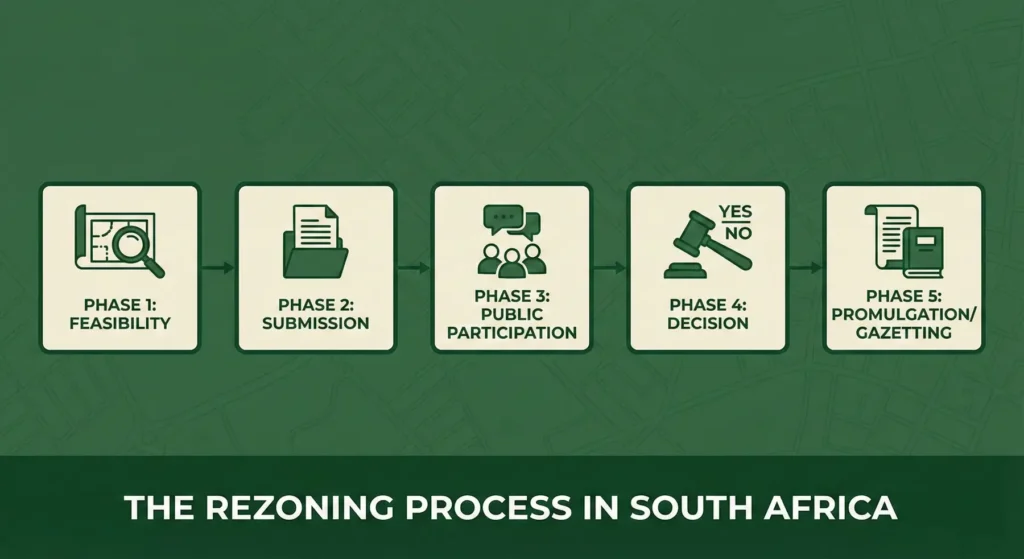
Phase 1: Feasibility and Inception (Weeks 1-4) #
- Site Assessment & Policy Alignment: We first analyze your property against the municipality’s core spatial policies. In Gauteng, for example, a successful application must tightly align with the Spatial Development Framework (SDF 2040) and the Nodal Review Policy. If your proposed use contradicts the municipality’s long-term vision—such as proposing heavy industrial use in an area strictly earmarked by the SDF for high-density residential corridors or transit-oriented development—the application cannot proceed. We identify these fatal flaws before you spend capital.
- Pre-consultation: We engage municipal officials early to identify “fatal flaws” like lack of bulk infrastructure (sewer/water capacity).
Phase 2: Submission and Circulation (Months 2-4) #
- The Motivation Report: This is the heart of your application. It acts as a legal argument proving “need and desirability.” We must prove your development won’t harm the local economy or environment.
- Circulation: Your application is sent to internal departments (Roads, Water, Electricity, Environmental Health). This is where most delays occur. If the Roads Agency requires a Traffic Impact Assessment (TIA), the clock stops until you provide it.
Phase 3: Public Participation (28 Days) #
You are legally required to notify the public via:
- Provincial Gazette notices.
- Local Newspaper advertisements.
- Site Notices (placards) placed prominently on your boundary.
- Registered Letters to adjacent neighbors.
Phase 4: The Decision (Months 2-4) #
- Municipal Planning Tribunal (MPT): If there are objections, your application goes to a tribunal. This is a quasi-judicial hearing where your town planner argues against objectors.
- Outcome: The application is Approved, Approved with Conditions, or Refused.
Phase 5: The “Gap” (Promulgation) #
Receiving an approval letter does not mean you can start building immediately. Once the tribunal approves the application, the new rights must be Promulgated (published in the Provincial Gazette) to become law. This can only happen once all pre-proclamation conditions are met (such as paying bulk contributions or upgrading an electrical substation).
The Glensburg Difference: We actively manage this administrative “gap” phase to ensure your rights don’t sit in limbo at the Council’s legal department.
The Costs: Budgeting for Rezoning #
Clients often ask, “How much does rezoning cost?” The answer is threefold.
| Cost Component | Estimate (ZAR) | Description |
|---|---|---|
| Municipal Application Fees | R7,000 – R12,000 | Paid directly to the Council. (e.g., City of Joburg 2025/2026 tariffs). |
| Professional Fees | R25,000 – R85,000+ | Town planner fees for drafting, submission, and project management. Varies by complexity. |
| Specialist Studies | R15,000 – R50,000+ | If required: Traffic Impact Assessments, Environmental screenings, or Geotechnical reports. |
| Advertising Costs | R3,000 – R8,000 | Gazette and newspaper placements. |
| Development Contributions | Variable | (See Below) – This is often the hidden “shock” cost. |
The Hidden Cost: Development Contributions (Bulk Contributions) #
When you increase the rights on a property (e.g., from 1 house to 20 apartments), you burden the city’s infrastructure. The municipality calculates a one-off levy for this increased load on roads, sanitation, and water. For example, a rezoning in Sandton could trigger a Bulk Contribution of R100,000 to R500,000+ depending on the scale. This is payable before you can exercise your new rights (Phase 5).
Handling Objections & Risks #
“Will my neighbors stop the development?” #
- Invalid Objection: “I don’t want a business here because it will devalue my property” (without proof) or “I don’t want competition for my own shop.”
- Valid Objection: “The development will cause traffic gridlock on a quiet cul-de-sac” or “The building height invades my privacy.”
- Our Role: We draft a “Reply to Objections,” legally dismantling invalid arguments and proposing technical solutions (like screening walls or traffic circles) for valid ones.
“How long does it really take?” #
Being realistic, a clean application with no objections might take 6-9 months. A complex application with objections and tribunal hearings can take 18 months. Strategy: In Johannesburg, we often run the Site Development Plan (SDP) preparation in parallel with the final stages of rezoning to save time once approval is granted.
Why Applications Fail #
- Poor Policy Alignment: Failing to align with the Municipality’s spatial vision (e.g., the Nodal Review in Johannesburg or MSDF in Cape Town). If the city wants densification near corridors and you propose low-density housing, you are misaligned.
- Infrastructure Lack: Proposing high-density units in an area with no sewage capacity.
- Restrictive Conditions: Winning the rezoning but failing to remove a restrictive title deed condition. You legally still cannot build.
Conclusion: The Value of Expertise #
Rezoning is not an administrative task; it is a development rights acquisition strategy. At Glensburg Town Planners, we don’t just “submit plans”; we engineer the application to align with Council policy, mitigating risk and maximizing your property’s yield. Ready to find out what your property is truly worth? Don’t spend money on an application before you know the facts. Contact Glensburg Town Planners today for a comprehensive Feasibility Report to map out your risks and opportunities.
Frequently Asked Questions #
#
Rezoning in South Africa #
Is rezoning the same as removing a restrictive condition from my Title Deed?
No, they are two distinct legal processes, though they often need to be done simultaneously. Your property’s zoning is governed by the municipal Town Planning Scheme, while a Title Deed is a legal contract registered at the Deeds Office. You may successfully rezone a property to “Business 1,” but if your Title Deed contains an old, restrictive condition stating “this land may only be used for residential purposes,” you still cannot legally operate a business. A concurrent application for the Removal of Restrictive Conditions is required.
Can I apply for rezoning if I am running an illegal land use and received a Contravention Notice?
Yes. If you have received a Contravention Notice from the municipality (e.g., running an unauthorized commune or mechanic shop), applying for rezoning is the formal process to regularize and legalize your activities. However, submitting the application does not automatically grant you amnesty; you may still be required to pay administrative penalty fees, and the municipality may order you to cease operations until the rezoning is officially promulgated.
What are Development Contributions (Bulk Contributions), and when do I have to pay them?
Development Contributions are a one-off capital levy charged by the municipality when a rezoning application increases the density or land use rights of a property. Because a new apartment block or commercial center places a higher burden on municipal infrastructure (water, sewer, roads, and electricity), the developer must pay this fee to upgrade the bulk services. These figures are calculated by municipal engineers and must typically be paid before the new zoning rights are promulgated and before building plans can be approved.
Will my municipal property rates increase the moment I submit a rezoning application?
No. Your municipal rates are tied to the property’s current zoning and its value on the municipal General Valuation (GV) Roll. Your rates will only increase after the rezoning application is fully approved, promulgated in the Provincial Gazette, and the property is categorized under its new use during a supplementary valuation cycle.
If my neighbours object to my rezoning application, does it automatically fail?
Absolutely not. The municipality evaluates objections based on technical and statutory validity, not emotion. If a neighbour objects because they fear “increased competition” or make unsubstantiated claims about “property devaluation,” the objection carries little legal weight. However, valid town planning objections, such as concerns over severe traffic impact, privacy invasion, or strain on the sewer network, must be formally addressed. If objections cannot be resolved, the application is referred to the Municipal Planning Tribunal (MPT) for a formal hearing, where we present expert testimony to defend your development rights.
Can a rezoning application in South Africa be legally “fast-tracked”?
There is no legal mechanism to bypass or shortcut the statutory timeframes mandated by SPLUMA, such as the mandatory 28-day public participation period or the external departmental circulation phase. However, an application is expedited through perfect preparation. Delays almost always stem from submitting incomplete motivation reports, failing to align with the Spatial Development Framework, or having to commission reactive specialist studies (like a Traffic Impact Assessment) late in the process.
What is a Site Development Plan (SDP), and how does it relate to my rezoning?
Rezoning grants you the legal right to use the land for a specific purpose (e.g., High-Density Residential). A Site Development Plan (SDP) is the architectural execution of that right. The SDP details the exact placement of buildings, parking bays, refuse areas, and landscaping on the site. In many municipalities, including the City of Johannesburg, an approved SDP is a mandatory condition of the rezoning approval and must be signed off before you can submit final building plans for construction.
I received my rezoning approval letter. Can I start building immediately?
No. An approval letter simply means the municipality has agreed to grant the rights. Before you can break ground, you must complete the final administrative phase: Promulgation. This involves fulfilling any pre-promulgation conditions (such as paying Bulk Contributions or registering servitudes) and having the decision published in the Provincial Gazette. Only then are the new rights legally enacted, allowing for the approval of your building plans.
Disclaimer #
Because every property has unique zoning constraints and municipal bylaws are subject to change, this article serves as a general guide rather than site-specific counsel. See our Editorial Policy