

Whether you are a commercial property developer looking to maximize the yield on a new acquisition, an investor seeking to understand municipal by-laws, or a landowner wanting to subdivide a residential stand, you will inevitably encounter the need for a town planner. But what exactly is a town planner, and why are they the linchpin of successful property development in South Africa? In this comprehensive guide, Glensburg Town Planners breaks down the profession, the regulatory landscape, the different types of planners, and the immense value these professionals bring to your property development journey.
1. What is a Town Planner? #
At its core, town planning (also known as urban and regional planning) is the dynamic profession of designing, managing, and guiding the use of land and resources. It is the science and art of creating environments where people can live, work, and thrive sustainably.
A Town Planner is a highly qualified professional who applies technical knowledge, regulatory expertise, and creative problem-solving to shape how land is used. They sit at the intersection of architecture, civil engineering, environmental science, and municipal law. While architects design the buildings and engineers calculate the infrastructure, town planners ensure that the development is legally permissible, optimally located, and aligned with the long-term spatial vision of the city.
In South Africa, town planners operate within a complex legislative framework, most notably governed by the Spatial Planning and Land Use Management Act 16 of 2013 (SPLUMA). They act as the bridge between private developers’ commercial ambitions and the government’s regulatory requirements, ensuring that economic growth aligns with spatial justice, environmental sustainability, and community well-being.
2. Types of Town Planners in South Africa #
The town planning profession is incredibly broad, and practitioners often specialize in distinct fields. Understanding these nuances is crucial when seeking the right expertise for your specific project.
a) Development Planners #
Development planners focus on the macroeconomic “big picture;” forward planning that also include spatial planning. They are responsible for formulating long-term strategies and policies that dictate how cities, municipalities, and regions will grow over the next 10 to 50 years.
- Key Deliverables: Drafting Spatial Development Frameworks (SDFs), Integrated Development Plans (IDPs), and local precinct plans.
- Focus: They analyze demographic data, economic trends, and bulk infrastructure capacity to determine where future residential hubs, industrial nodes, and transport corridors should be located to prevent urban sprawl.
b) Land Use Management Planners #
These planners operate at the micro-level, dealing with specific parcels of land. They are the regulatory gatekeepers who ensure that individual developments comply with existing zoning schemes and municipal by-laws what is commonly referred to as development control.
- Key Deliverables: Processing and evaluating statutory applications for rezoning, subdivisions, consolidations, and consent uses.
- Focus: They assess the immediate impact of a proposed development on traffic, neighboring property values, and local engineering services.
c) Urban Designers #
Sitting between town planning and architecture, urban designers focus on the aesthetic, physical, and functional design of public spaces. They look at how buildings interact with streets, parks, and pedestrian walkways to create cohesive, attractive, and safe urban environments.
d) Transport Planners #
These specialists focus purely on the movement of people and goods. They plan road networks, public transit systems, and non-motorized transport routes to alleviate congestion, integrating deeply with land use planners to create transit-oriented developments.
3. What Qualifies a Town Planner? #
Not just anyone can call themselves a town planner. In South Africa, the profession is strictly regulated to protect the public, ensure ethical practice, and maintain a high standard of development.
a) The Educational Qualifications #
A prospective town planner must complete a rigorous, accredited qualification at a recognized university. This typically involves a Bachelor of Town and Regional Planning (NQF Level 7 or 8) or a Master’s degree in City and Regional Planning. Coursework covers urban economics, environmental law, geographic information systems (GIS), sociology, and civil engineering principles.
b) SACPLAN Accreditation #
The South African Council for Planners (SACPLAN) is the statutory body established under the Planning Profession Act (Act 36 of 2002) to regulate the profession. Registration with SACPLAN is a requirement for professional practice. The registration journey involves:
- Candidate Planner: After graduation, a planner must register as a Candidate and complete a minimum of 24 months of practical training under the direct supervision of a Registered Professional Planner.
- Technical Planner: Individuals with specific technical qualifications (such as a National Diploma) who have met the practical experience requirements for technical planning work.
- Professional Planner (Pr. Pln): After demonstrating independent competency, completing the practical training, and passing rigorous professional assessments, a candidate is elevated to a Professional Planner.
When you hire Glensburg Town Planners, you are engaging with SACPLAN-registered professionals. This guarantees that your project is handled by experts bound by a strict code of ethics, possessing up-to-date knowledge of municipal by-laws, and carrying the legal authoriThe Strategic Value of Hiring a Town Plannerty to submit and motivate statutory land development applications.
4. The Strategic Value of Hiring a Town Planner #
Many property investors mistakenly view town planning as a mere administrative hurdle or a begrudging municipal requirement. In reality, a skilled town planner is an essential strategic partner who can significantly increase the profitability of a development while mitigating catastrophic financial risks.
a) Due Diligence Before Purchasing Land #
Never purchase land or property for development without consulting a town planner first. What looks like a perfect site for a high-density apartment block might have hidden legal or spatial encumbrances. A town planner conducts comprehensive due diligence to uncover:
- Current Zoning: What are the default land use rights? (e.g., Residential 1 vs. Residential 3).
- Development Controls: What are the height restrictions, Floor Area Ratios (FAR), building lines, and coverage limits?
- Title Deed Restrictions: Are there archaic restrictive conditions (like a “single dwelling only” clause) registered against the title deed that must be legally expunged?
- Environmental & Heritage Constraints: Does the property fall within a wetland buffer zone, a dolomite risk area, or a protected heritage overlay?
b) Feasibility Studies and Maximizing Yield #
A town planner assesses the highest and best use of a property. If you own a large stand, they will calculate the maximum number of units you can legally build, the parking requirements, and the spatial layout required to get municipal approval. They ensure your commercial vision aligns with what the local authority’s spatial policies will actually support.
c) Navigating SPLUMA and Municipal Bureaucracy #
The bureaucratic red tape of local municipalities can paralyze a project. Town planners speak the language of the municipality. They understand the nuances of SPLUMA, know exactly which departments must circulate your application (e.g., Roads Agency, Water and Sanitation, Environmental Health), and actively drive the application through the system to prevent it from stalling on a municipal official’s desk.
d) Dispute Resolution and Public Participation #
Development often attracts objections from neighbors or community groups. A professional town planner manages the statutory public participation processes, mediates disputes, and prepares robust scientific and legal motivations to counter objections, ensuring your application stands up to scrutiny at the Municipal Planning Tribunal.
5. What Do Town Planners Do Day-to-Day? #
At Glensburg Town Planners, our portfolio of services encompasses the full spectrum of land development applications:
- Rezoning (Amendment Schemes): Changing the legal use of a property (e.g., converting a residential home into a commercial office block, a shopping center, or a high-density townhouse complex).
- Subdivisions: Dividing a single piece of land into multiple smaller, legally independent portions, each with its own title deed.
- Consolidations: Combining two or more adjacent properties into a single legal entity to create a larger, unified development footprint.
- Township Establishment: The highly complex process of converting raw, agricultural land into a proclaimed urban township with dedicated streets, public open spaces, and zoned residential or commercial erven.
- Consent Uses: Applying for secondary rights permitted under the current zoning scheme (e.g., running a small guesthouse, a spaza shop, a place of instruction, or a home-based enterprise without fully rezoning the property).
- Removal of Restrictive Conditions: Applying to the courts or the municipality to remove outdated clauses from a property’s title deed that prevent modern development.
6. Town Planning Scenarios in South Africa #
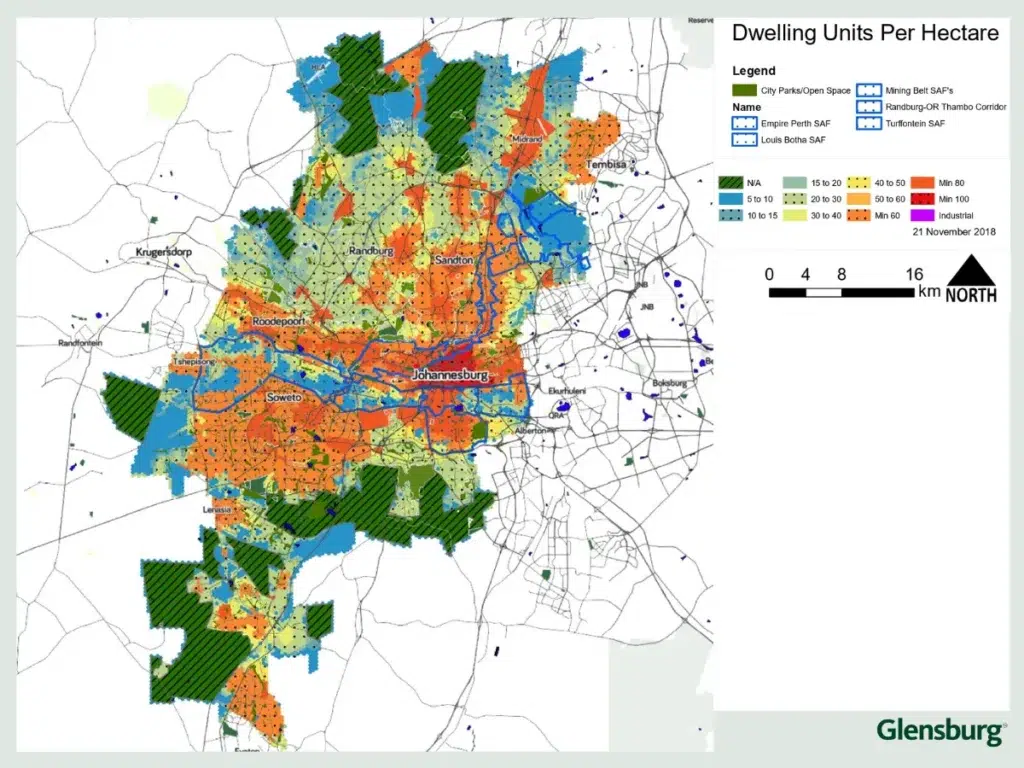
To truly understand the return on investment of hiring a professional town planner, we need to look at how municipal by-laws, spatial policies, and property economics collide in the real world. Below are three highly common property development scenarios that illustrate exactly how a town planner navigates the complexities of land development in dynamic environments like Johannesburg and the broader Gauteng economic hub.
Scenario 1: The High-Density Transit-Oriented Development (TOD) #
The Situation: A property investor acquires a standard, single-dwelling residential property (zoned “Residential 1”) in a rapidly densifying node, such as Rosebank or near a major Gautrain or Bus Rapid Transit (BRT) station.
The Goal: The developer wants to demolish the aging house and construct a four-story, 30-unit apartment complex to cater to young professionals, maximizing the rental yield of the land.
The Town Planner’s Approach:
- Strategic Feasibility: Before an architect sketches a line, the town planner cross-references the property against the City of Johannesburg Land Use Scheme and the city’s latest Nodal Review Policy. They confirm the municipality actively encourages high-density “Residential 3” or “Residential 4” developments in this specific transit corridor.
- Assembling the Team: The planner advises the developer that a project of this scale triggers specific infrastructure upgrades. They coordinate specialized consultants, including traffic engineers for a Traffic Impact Assessment (TIA) and civil engineers for a bulk services report.
- Drafting the Motivation: The town planner compiles a robust legal and spatial motivation proving that the 30-unit complex aligns with SPLUMA principles—specifically focusing on spatial efficiency and combating urban sprawl.
- Handling Objections: High-density rezonings often attract objections. The town planner manages public participation, formulates technical responses to objectors, and legally represents the developer at the Municipal Planning Tribunal to secure final approval.
Scenario 2: The Classic Suburban Subdivision #
The Situation: A homeowner in a traditional, leafy suburb like Bryanston or Randburg sits on a massive 4,000 square meter stand. The maintenance costs are high, and they want to unlock the latent equity tied up in the land.
The Goal: Legally subdivide the property into four separate 1,000 square meter portions, retaining the main house on one portion and selling off the other three as vacant stands to bespoke developers.
The Town Planner’s Approach:
- Title Deed Due Diligence: The town planner pulls the historical Title Deed and discovers an archaic restrictive condition stating: “Not more than one dwelling house shall be erected on the erf.” The Simultaneous Application: Instead of running two separate, drawn-out processes, the town planner submits a simultaneous application for the Removal of Restrictive Conditions and the Subdivision of the land.
- Spatial Layout & Access: Working alongside a Professional Land Surveyor, the town planner designs the subdivision layout. They ensure each new portion meets the minimum stand size dictated by the local zoning scheme and design a legally compliant “panhandle” driveway for guaranteed access.
- Service Clearances: The planner liaises with municipal entities (like Johannesburg Water and City Power) to determine where the new sewer connections and electrical meters will go, ensuring the subdivided portions can practically function as independent properties.
Scenario 3: Legalizing a Commercial Enterprise (Consent Use) #
The Situation: An entrepreneur has been running a successful boutique digital marketing agency from their home. As the team grows, neighbors complain about parked cars on the pavement, and a municipal inspector issues a compliance notice for illegal land use.
The Goal: Legalize the business operations without going through the lengthy and expensive process of a full commercial rezoning.
The Town Planner’s Approach:
- Assessing the Rights: The town planner evaluates the current zoning and notes that the local town planning scheme allows for a “Home Enterprise” or “Professional Office” via a Consent Use application.
- Site Development Plan (SDP): The planner advises the owner on modifying their property layout to comply with municipal parking ratios (e.g., creating dedicated off-street parking bays inside the property boundary).
- Application and Motivation: They submit a Consent Use application, legally motivating that the business is low-impact, does not generate excessive noise, and provides a localized economic benefit without detracting from the neighborhood’s residential character.
7. Town Planning Applications Timelines #
One of the most frequent questions developers ask is, “How long will this take?” Town planning is a statutory process governed by strict legislative timelines. While timeframes vary by municipality and project complexity, a standard rezoning or subdivision follows this general lifecycle:
- Phase 1: Pre-Consultation & Preparation (2 – 4 Weeks): Information gathering, conducting due diligence, instructing land surveyors, pulling title deeds, and drafting the legal motivation memorandum.
- Phase 2: Submission & Circulation (2 – 4 Weeks): The application is formally submitted to the municipality. The city then circulates the application to internal engineering departments (Water, Roads, Electricity, Environment) for their official comments.
- Phase 3: Public Participation (4 Weeks): Site notices are placed on the property boundary, letters are sent to adjacent neighbors, and notices are published in the Provincial Gazette and local newspapers. The public has 28 days to lodge any formal objections.
- Phase 4: Evaluation & Tribunal (2 – 4 Months): If there are no objections, the municipal town planner evaluates the application and drafts a recommendation report for approval. If there are objections, the application must be heard before the Municipal Planning Tribunal, which extends the timeline significantly.
- Phase 5: Post-Approval & Promulgation (1 – 3 Months): Once approved, the developer must pay bulk engineering contribution figures (if applicable) and comply with pre-promulgation conditions before the new zoning rights are officially published in the Provincial Gazette and come into operation.
Total Estimated Timeline: A standard rezoning application generally takes between 6 to 12 months from submission to final promulgation, underscoring the necessity of having a proactive town planner driving the process.
8. Why Choose Glensburg Town Planners? #
In a rapidly evolviving property development industry, hiring professionals who are experienced, accredited and trustyworthy is important. At Glensburg Town Planners, town planning is not just a legal process of filling out municipal forms to acquire land use rights; we provide strategic advisory services designed to maximize your asset’s value.
While some agencies offer specialised yet fragmented services, Glensburg Town Planners provides an end-to-end turnkey solution. We collaborate seamlessly with top-tier architects, civil engineers, land surveyors, and environmental consultants to ensure your project moves from a conceptual sketch to a fully authorized construction site. Our deep-rooted understanding of complex municipal environments and rapid urbanization challenges allows us to anticipate roadblocks before they cost you time and money. Investing in professional town planning is not a sunk cost; it is a critical strategy for risk mitigation and asset optimization.